
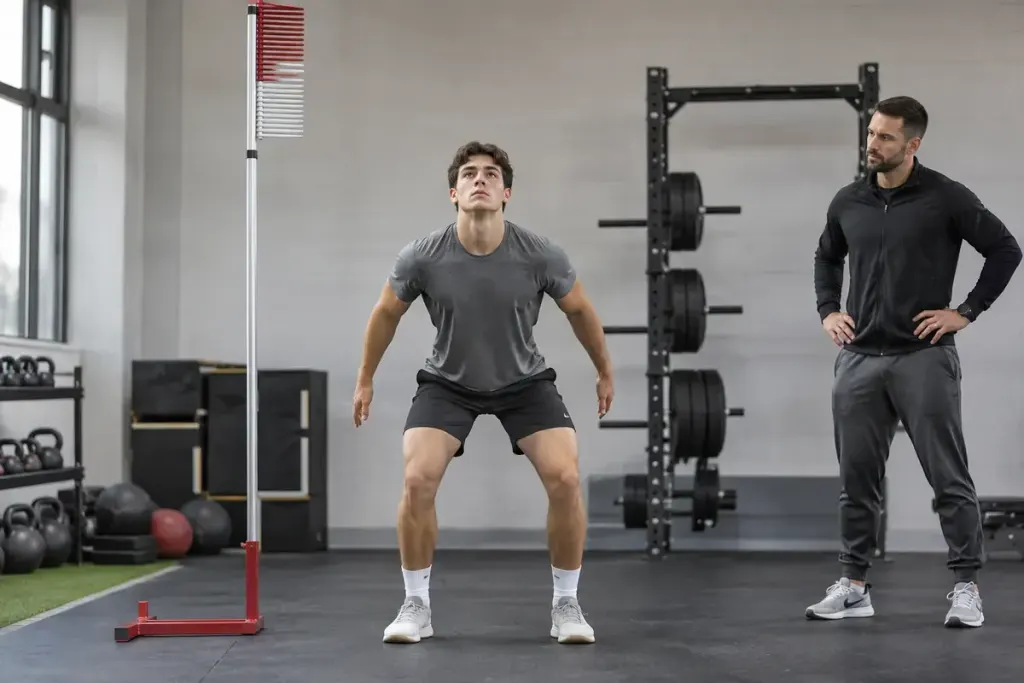
Two jump scores may both be recorded in centimetres and still describe different tests. In a countermovement jump, the athlete begins upright, moves down and immediately reverses into the jump. A squat jump begins from a held flexed position and is intended to exclude that preliminary downward movement.
A research study comparing squat and countermovement jumps treats them as distinct tasks. Its experimental setup is a useful reminder that a published result belongs to a defined protocol. It does not establish one universal squat depth, pause duration or testing routine for every athlete.
Give the test its full name
A training log headed simply “vertical jump” can hide a change in method. Record whether the attempt was a squat jump or a countermovement jump, whether the arms were held in a specified position, and which measurement system was used. If a coach sets a particular starting position or pause, keep that instruction with the record.
For example, an athlete might record 28 centimetres in a squat jump and 32 centimetres in a countermovement jump. Those figures are illustrative, not targets. Treating the second as an improvement over the first would ignore the change in task. A more meaningful comparison follows repeated attempts using the same agreed procedure.
Watch the start as well as the landing
A small dip before a supposed squat jump can turn the attempt into something closer to a countermovement jump. The numerical result may look perfectly tidy while the movement no longer matches the test label. A coach can decide whether an attempt meets the protocol and how to record an invalid trial.
Keep the warm-up, instructions, rest arrangements and equipment consistent enough for the intended comparison. Do not add extra attempts simply to chase a preferred number; use the planned testing procedure.
Jump testing should also be suitable for the person and the setting. These scores are not a diagnosis of an injury or a stand-alone return-to-sport decision. Their everyday value is narrower: with a clear method, the record tells you what was tested instead of making unlike movements appear interchangeable.