
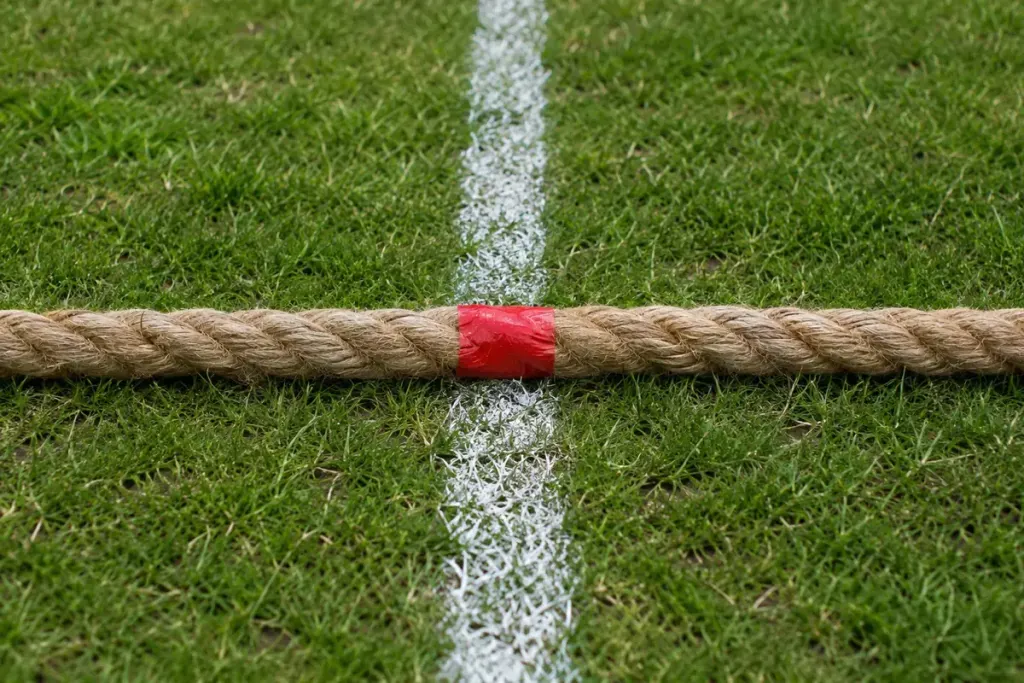
When a tug-of-war contest slows to a near standstill, the rope can tell you more than the athletes’ expressions. Its marks show where the pull began and how far it has moved. Learning which mark to watch makes a close contest easier to follow.
The TWIF August 2026 rules specify five outdoor rope marks: one at the centre, a pair four metres from it, and a pair five metres from it. The three groups use different colours. At the start, the central rope mark is positioned above the ground’s centre line.
Follow the winning distance, not just the first movement
In an outdoor pull, bringing the opposing side’s four-metre mark beyond the ground centre line completes the required distance. Moving the rope’s centre a little towards one team is progress, but it is not yet that finish. A pull can also be decided by the judge disqualifying the other team.
The outer five-metre marks serve a different purpose: the first pullers begin their grip close to those outer marks, outside the bounded central section. They are not an extra metre that must be gained after the winning side mark crosses.
A viewing exercise for a close pull
Choose a replay where the ground centre line remains visible. Before watching the athletes, locate the rope’s middle mark and identify the side mark travelling towards the line. Pause once near the start and again later. Comparing those positions can reveal progress that is hard to see in a tight shot of someone’s boots.
If the camera angle hides the line, resist estimating a result from body position alone. Wait for the official signal or a clearer replay. A cropped television image can make a small movement look decisive.
This guide concerns outdoor competition under TWIF rules. Indoor markings differ, and a local event may use its own arrangements. Once you know the event’s rules, the marks turn a seemingly static struggle into a contest with a visible distance still to travel.