
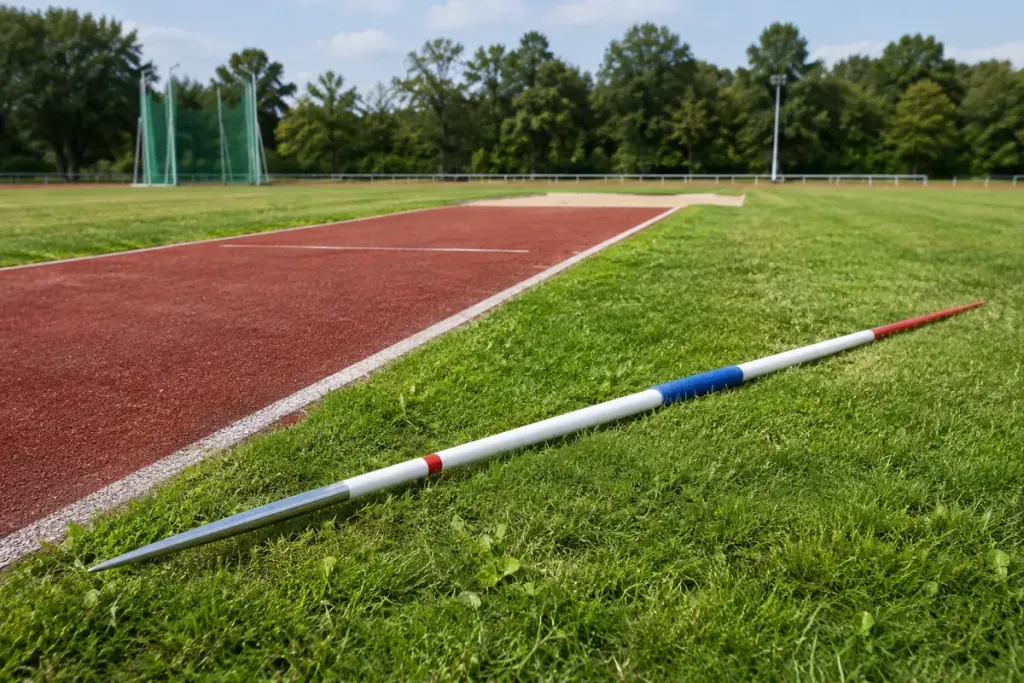
A javelin lands, bounces and lies flat. A viewer may assume that the throw failed because the implement did not remain stuck in the turf. The relevant landing question is which part touched the ground first, not whether the javelin stayed upright afterward.
World Athletics’ event guide states that the metal head must contact the ground before any other part and that the landing must be within the sector. The implement can move after that first contact, so its final resting position does not by itself explain the ruling.
Watch the first instant, then the official
On a replay, concentrate on the moment the javelin meets the ground. A distant camera angle can make the first contact difficult to distinguish. The visible end position may be much clearer, but it answers a different question.
An illustrative pair of throws shows the difference. One javelin’s head contacts first and then the shaft falls; another reaches the ground almost flat with a different part touching first. They may finish in similar positions while presenting different landing decisions.
A head-first landing is not the whole validity test
The athlete’s actions on the runway and at the throwing arc also matter. A throw can have an acceptable landing but still fail for another infringement. Avoid explaining a red flag solely from the image of the javelin in the grass.
Distance is measured from the nearest mark made by the head’s first contact to the prescribed point at the throwing arc, following the event’s measurement line. It is not measured to the tail or simply to wherever the implement stops sliding.
For a viewing notebook, use separate entries for landing, sector and athlete movement. Mark anything the camera did not show as unknown. That habit makes commentary more accurate and leaves room for the official view.
If you want to try the event, do so with qualified coaching at a controlled throwing facility. The landing sector must be kept clear, and retrieval follows the session’s instructions. Understanding the rule is a spectator skill; safely handling a javelin is a separate practical responsibility.