
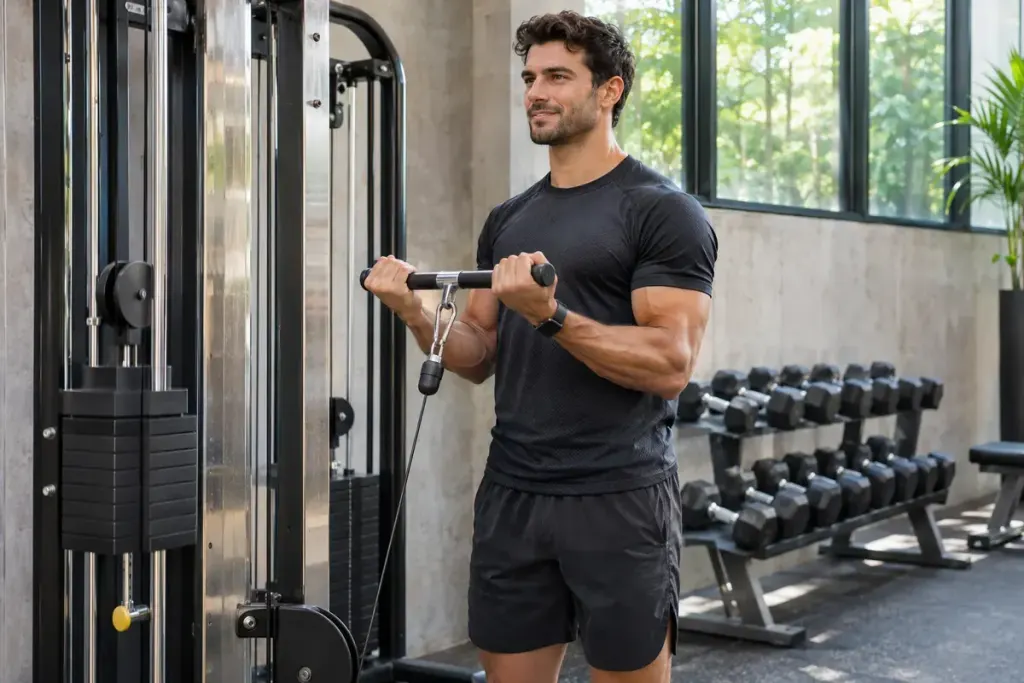
A dumbbell’s weight does not change as you lift it, yet the movement can feel harder in one position than another. One reason is geometry: the turning effect around a joint depends on the force’s line of action and its perpendicular distance from that joint.
A cable changes that line of action. It pulls toward the pulley rather than always vertically downward, so moving the pulley or changing your position can alter where the external load creates its greatest turning effect.
Think in lines, not just kilograms
OpenStax’s explanation of torque defines the perpendicular lever arm between a pivot and the force’s line of action. This basic mechanics principle helps explain equipment differences, although a human movement is more complex than a single rigid lever.
As an illustrative sketch, draw an elbow, a forearm, and a dumbbell. Add a downward arrow through the weight. The perpendicular distance from the elbow to that arrow changes as the forearm rotates. Now replace the downward arrow with a line toward a cable pulley. The geometry is different even before considering muscle anatomy.
This is not a calculation of the exact force inside someone’s joint. Body segments, acceleration, technique, and individual anatomy add further factors.
Compare the setup as well as the label
When recording a cable exercise, note pulley height, attachment, and body position alongside the selected load. Two sessions labelled “10 kg cable work” may describe different mechanical arrangements. Pulley systems can also mean that the stack label is not identical to the force at the handle.
Use a qualified coach to help select and demonstrate an appropriate setup, especially when learning an unfamiliar movement. Do not increase load simply to make the numerical comparison with a dumbbell look equal.
The useful takeaway is observational: ask where the force points and how that changes through the movement. A constant weight is not a constant joint torque, and a cable is not automatically harder everywhere. Understanding the setup makes a training note more meaningful without pretending that one diagram can prescribe the best exercise for every person.