
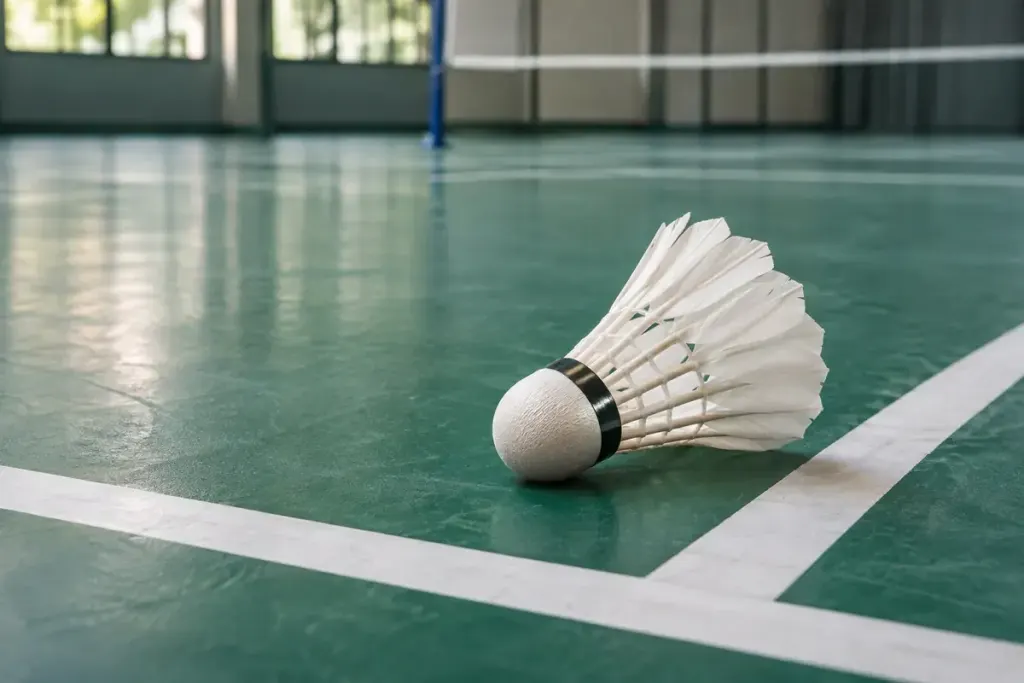
A shuttle that feels fast in a rally may have been hit harder, struck at a different height or carried on a different trajectory. Badminton’s formal speed test reduces that guesswork by specifying the stroke and where the shuttle should land.
The reference is Law 3 in the BWF Laws of Badminton, 26 April 2025 edition. Use the regulations adopted for the actual competition if its documents specify a different edition.
The starting point matters
The test uses a full underhand stroke, with contact over the back boundary line. The shuttle travels upward and parallel to the sidelines. This is a particular test action, not an invitation to compare whichever clear or smash happens to feel comfortable.
A shuttle of correct speed lands at least 530 millimetres and no more than 990 millimetres short of the opposite back boundary line. Both distances are measured inward from that far back line. They are not measurements beyond the court, nor a target based on the short service line.
Before trying to interpret a landing, identify the relevant lines. Shared sports halls often have several overlapping court markings, and even badminton itself has different service boundaries for singles and doubles. Start with the full court’s back boundary, not a nearby coloured line that merely looks plausible.
Make the comparison repeatable
For a practice session, ask an experienced player or coach to demonstrate the prescribed stroke. Keep the hitting direction and starting position consistent when comparing shuttles. If one attempt is badly mishit, its landing tells you little about speed.
In competition, follow the official’s procedure rather than altering a shuttle on your own. The purpose of the test is a consistent playing condition, not choosing whichever flight suits a particular player’s tactics.
A simple court-side note can record the shuttle type, the conditions and what the test showed. It is more useful than the statement “these are always too fast,” which may combine experiences from different halls and temperatures. Most importantly, retain the distinction between the specified speed test and an ordinary shot: the landing interval only makes sense alongside the stroke that produces it.