
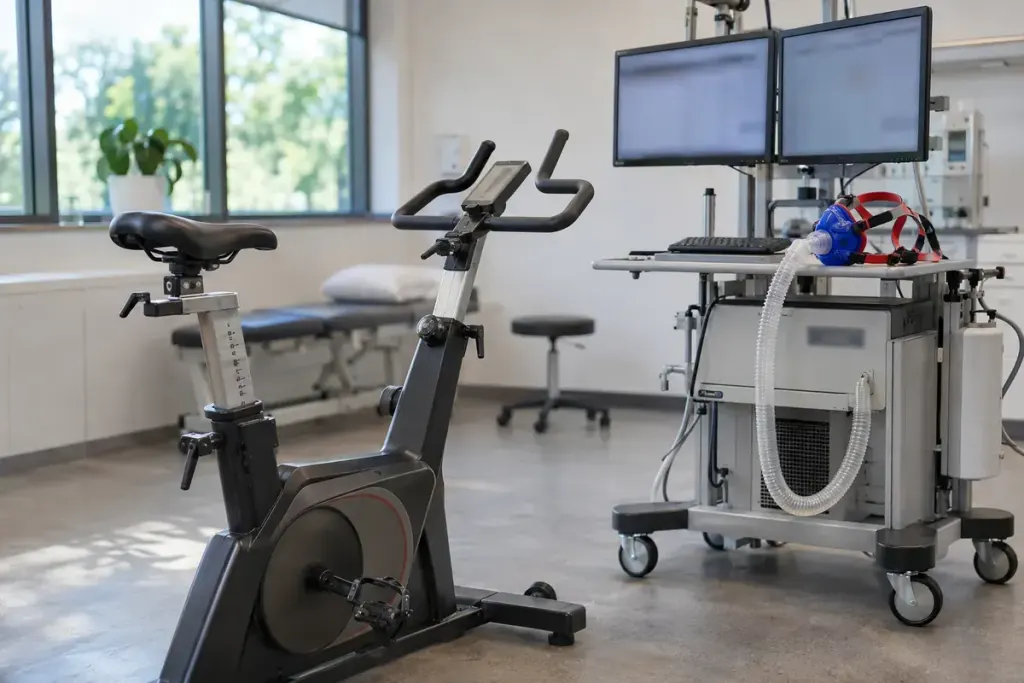
A fitness report gives one oxygen-consumption value in litres per minute and another in millilitres per kilogram per minute. These can describe the same measurement in different ways. Comparing the bare numbers without their units creates an immediate misunderstanding.
The Nicholas Institute’s explanation of maximum oxygen consumption distinguishes an absolute amount from a value adjusted for body mass. The latter lets the reader relate oxygen uptake to the size of the person rather than treating both expressions as interchangeable scores.
One fictional result, two expressions
For a purely arithmetic example, suppose an absolute value is 3.0 litres per minute for a person weighing 75 kilograms. Convert litres to millilitres first: 3.0 litres is 3,000 millilitres. Then divide by body mass:
3,000 ÷ 75 = 40 millilitres per kilogram per minute.
The numbers 3.0 and 40 are not two competing assessments. They express the example on different scales. These invented values are not a personal fitness target or a judgment about what is normal for a reader.
Keep the method beside the units
A laboratory report and a wearable estimate may arrive through different methods. Record how the value was obtained, the date and the activity involved. Ask the qualified professional interpreting a test what comparisons are appropriate rather than combining every number from different devices into one trend.
Body mass is part of the denominator in the relative expression. A change in that denominator can affect the result even if the absolute figure is unchanged. This arithmetic is a reason to interpret the measurement carefully, not advice to pursue weight loss to improve a displayed score.
Do not attempt an unsupervised maximal exercise test simply to obtain a number. Appropriate testing and interpretation depend on health and circumstances. For an ordinary training log, preserving units and method is already a useful improvement: it makes the record intelligible before anyone tries to draw a performance conclusion.