
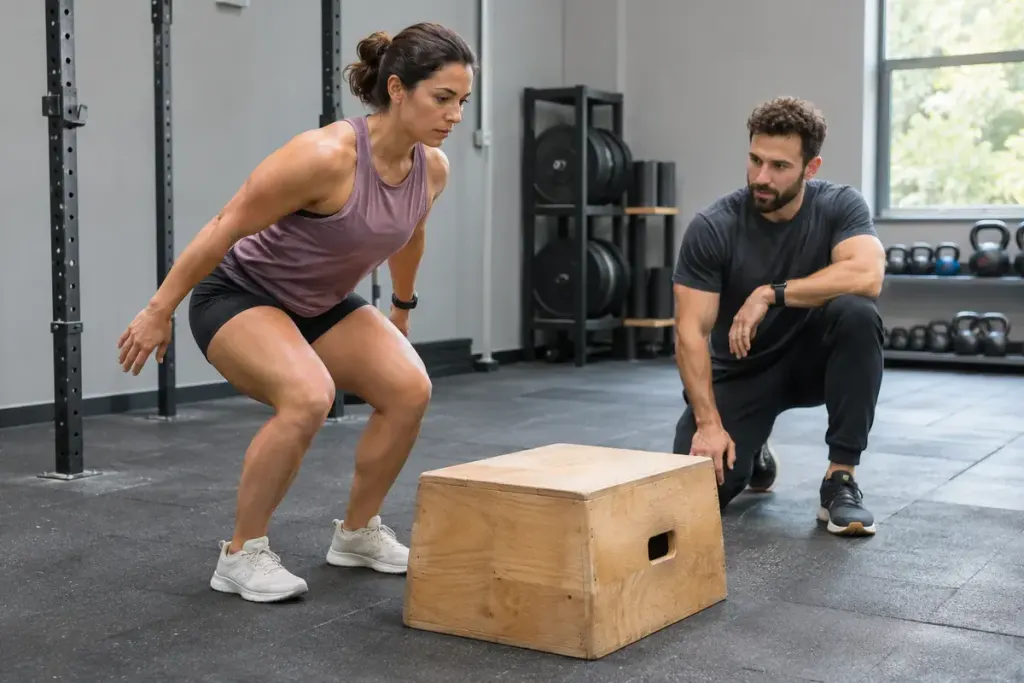
Two athletes can move the same load and produce different movement speeds. That difference helps explain why strength and power are related without being identical. A programme aimed at expressing force quickly asks a different question from one focused only on the greatest force an athlete can produce.
In a simple linear mechanical description, power is the rate of doing work and can be expressed as force multiplied by velocity in the direction of movement. The National Strength and Conditioning Association discusses strength as dependent on movement velocity, rather than as one number detached from the task.
The exercise determines what the number means
A heavy lift, a jump and a throwing action involve different movements, equipment and measurement choices. A result from one does not automatically describe performance in another. Even the word “speed” needs context: bar speed, running speed and the speed of a ball leaving the hand are different quantities.
Consider an illustrative comparison in a supervised setting. An athlete might complete a controlled heavy repetition and a lighter repetition intended to move quickly. The load, movement, range and technique must all be known before the two attempts can say anything useful about the training goal. The lighter attempt is not automatically better, and the heavier one is not automatically more powerful.
The NSCA’s discussion of force, velocity and power profiles shows why these relationships are examined across conditions. They are not a reason for a beginner to improvise maximum-effort tests.
Ask what the session is trying to develop
When reviewing a programme with a qualified coach, ask which movement or sporting demand the exercise supports, how good technique is judged and what should happen when speed or control declines. Rest, fatigue and the athlete’s experience affect whether the intended quality can be practised well.
Do not combine extra load and extra speed simply because both appear in an equation. Appropriate exercise selection, progression and supervision come first. Stop an exercise that causes pain or feels unsafe and seek suitable guidance.
For your training notes, record the exercise, load, repetitions and relevant quality observations instead of labelling everything “power work”. Clear language makes it easier to understand whether a session is developing capacity, practising fast expression or merely becoming more tiring.