
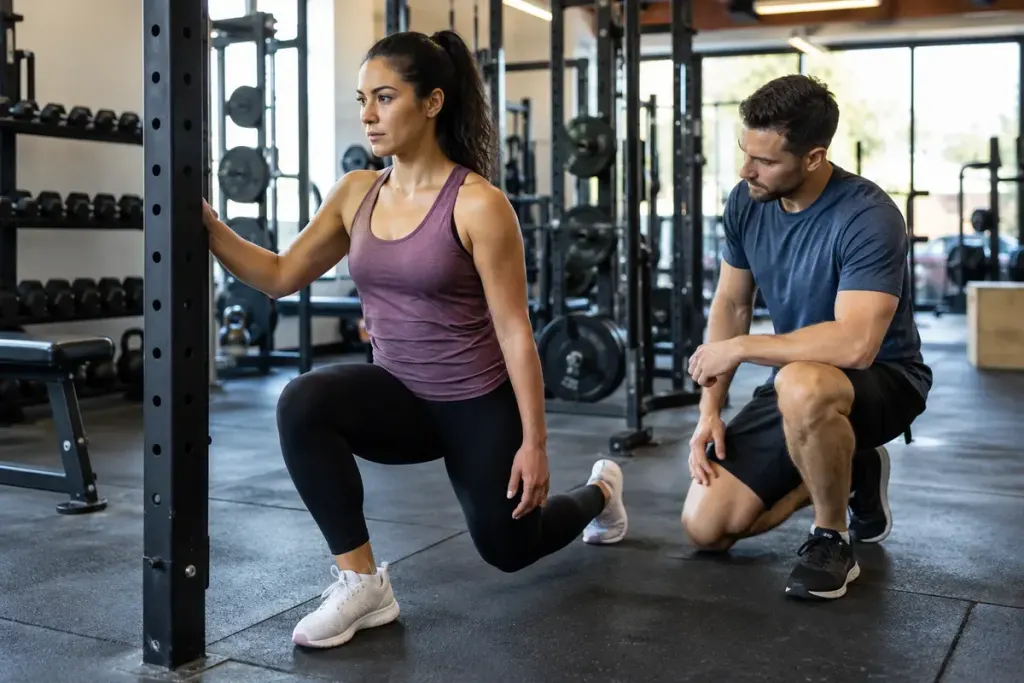
“Three sets of ten” looks clear until you return to the exercise a week later and cannot remember whether ten meant each leg or both legs combined. A single-leg movement needs a counting convention that survives beyond the session itself.
Write the side next to the repetitions. For example, an invented log might read: “Split squat, set 1: left 8, right 8.” That describes 16 repetitions across both sides, but eight for each leg. It is not the same entry as eight alternating repetitions total.
Give the log four pieces of information
- Movement: use the same exercise name and variation each time.
- Repetitions: record each side explicitly.
- Load: state the weight arrangement clearly, including whether a number refers to each implement or the combined load.
- Order and rest: note whether you alternate sides or complete one side first, and how the planned rest is applied.
This is a record-keeping example, not a prescribed workout. Follow an appropriate programme and qualified coaching where needed. Do not add repetitions merely to make a total look symmetrical if technique deteriorates or the movement causes pain.
If one side completes fewer controlled repetitions, record what actually happened. A short note about the reason is more informative than silently changing the entry to match the other side. Avoid diagnosing the cause from one session; fatigue, setup and execution can all complicate a comparison.
When reviewing progress, compare like with like. A change from bodyweight to an added load, a different range of motion or a different support arrangement changes the task. The same repetition number may therefore represent a different session.
Choose one notation and keep it. “8/side” can be concise once its meaning is established, while separate left and right entries are better when you need to record a difference. The best training log is the one that lets you and your coach reconstruct the exercise accurately without guessing what the shorthand meant.