
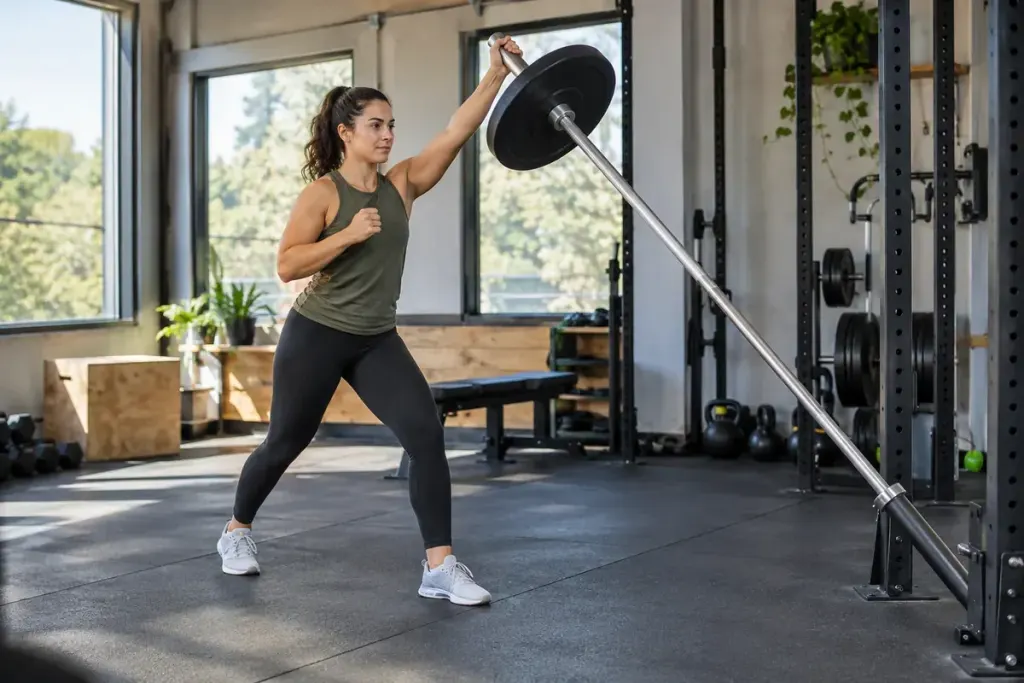
A landmine press moves the free end of an anchored bar through an arc. The path can feel different from lifting a dumbbell straight overhead, but the attachment does not remove the need for a stable setup and an appropriate load.
The American Council on Exercise’s landmine-training guide describes the anchored-bar arrangement and several exercises it supports. Choose a version suited to your experience rather than copying the most complex movement in a demonstration.
Check the anchor and the space
Use a purpose-made attachment installed according to its instructions, with the correct bar and a clear arc of movement. Ask gym staff to confirm unfamiliar equipment. Do not improvise an unstable corner arrangement or assume that a heavy object will safely hold the bar in place.
Make sure nobody is likely to cross the moving end of the bar. Check where the plates and your hands will travel at both ends of the movement, including when you lower the bar to finish the set.
Learn the movement before adding ambition
Begin with a manageable setup under qualified instruction. The unloaded bar can already be a meaningful load, so “no plates” does not mean “no resistance.” Let the coach help choose stance, grip and range for your ability.
A useful first-session observation is whether you can move smoothly without losing balance, shrugging through discomfort or twisting unexpectedly. If control disappears near the end of the set, stop rather than forcing the planned repetition count.
Record the variation and setup as well as the weight. A standing two-handed press and a half-kneeling single-arm press are not interchangeable entries in a training log. Changing stance, grip or range changes the task even if the plates remain the same.
Stop for sharp pain, dizziness or other concerning symptoms, and seek appropriate professional advice. An angled bar path is not a promise that an exercise suits every shoulder or medical condition.
The best starting point is a repeatable, controlled movement in a secure space. Once that is established, progression can be discussed in the context of the wider training plan instead of being driven by how much weight fits on the sleeve.