
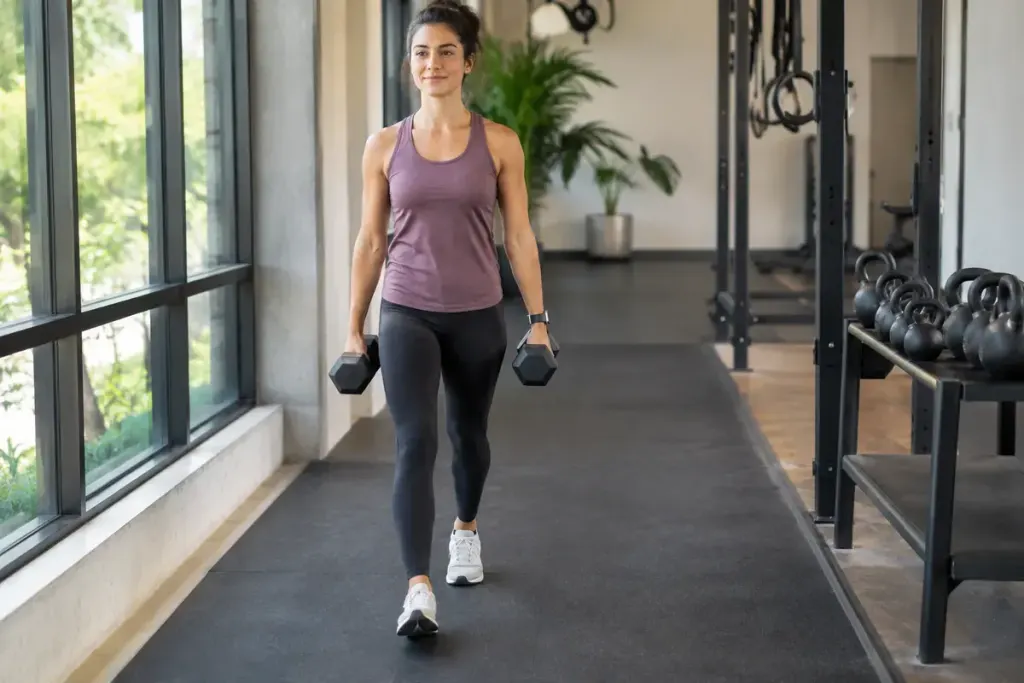
Picking up two weights and walking looks uncomplicated. A farmer’s carry becomes a useful exercise when the load, route and posture are chosen deliberately. If the weights pull you sideways or force a hurried shuffle, travelling farther is not necessarily an improvement.
The Force Fitness exercise guide describes carrying weights at the sides while walking naturally with an upright, controlled position. Use that as a description of the movement, not as a reason to copy a military training workload.
Before picking up the weights
Choose a clear, level route with enough space to turn and put the weights down safely. Remove trip hazards and avoid a route that crosses another person’s exercise area. Check that the handles are secure and that the load is manageable for both the pickup and the return to the floor.
For a first attempt, ask a qualified trainer to help choose an appropriate load and demonstrate the pickup. The carry should not begin with a lift you cannot control. A shorter, well-managed trial provides more useful information than a long walk that ends with the weights being dropped unexpectedly.
What to notice during the walk
- Are you walking steadily rather than rushing to finish?
- Can you keep the weights clear of your legs without exaggerated arm movement?
- Are your shoulders and trunk staying reasonably level?
- Can you maintain normal breathing rather than holding it for the whole distance?
These are observations to discuss with a coach, not a scoring system for diagnosing your body. Stop if the load becomes uncontrolled or you experience pain, dizziness or other concerning symptoms. Existing health concerns or injury may require individual advice before loaded exercise.
Record the implement, load, route length and how controlled the final steps felt. If you change the route, note the turns: repeatedly reversing direction makes a different task from walking the same total distance in a straight line.
Progress one element at a time under an appropriate programme. More weight, longer distance and less rest are separate changes, and combining all three makes the outcome difficult to interpret. The useful carry is one you can repeat with deliberate movement from pickup to put-down.